This article contains affiliate links. We may earn a commission if you buy through them.
You’re weighing whether a smart bottle is worth making room for in your bag. The Echo Water bottle conversation is really about whether a portable device that generates dissolved hydrogen fits your routine—how long a cycle takes, what ppm the brand states, how you actually use it, and what the stated coverage looks like if you change your mind.
For shoppers considering the ECHO Flask Hydrogen Water Bottle from Echo Water, the sections below use the brand’s published specifications and policies to explain exactly what the Flask is, what it isn’t, and the tradeoffs to keep in mind.
Echo Water bottle: quick verdict and how it works
If you want hydrogen‑rich water on demand in a portable format, the current ECHO Flask Hydrogen Water Bottle combines a proton exchange membrane (PEM) generator with a small touchscreen and optional app pairing. Echo Water lists Up to 6–8 ppm in 10–20 minutes depending on cycle length, in a 12 oz (0.36 L) capacity.
What the Flask is and does
The Flask’s PEM sits between platinum‑coated titanium plates. According to the brand, the membrane lets hydrogen dissolve into the water while a dedicated port vents oxygen into the air. That design is typical of PEM systems and explains two everyday behaviors: the bottle builds pressure while running a cycle, and the oxygen needs a safe path out. Echo Water’s posted lab numbers on distilled water report around 6.07 mg/L after a 10‑minute cycle and up to about 8.25 mg/L after 20 minutes, which aligns with the two cycle options shown on the tech specs.
The net effect is a small, rigid bottle that produces a known range of dissolved hydrogen rather than a general “sparkling” effect. If you want a simple carry-only bottle, this is more technology than you need. But if you specifically want hydrogen‑rich water and can live with short wait times, the Flask is built for that single job.
Who it suits—and what to weigh
Fit depends on whether short waits and routine care suit your day. A PEM with oxygen vent port means occasional moisture under the base can appear and is described as normal. To get the higher ppm the brand advertises, you’ll run the 20‑minute cycle and work within a 12‑ounce yield per round. The touchscreen is simple if you prefer not to use the app, and Bluetooth pairing adds tracking if you want it. If those tradeoffs sound workable, visit Echo Water to see the full specs and the brand’s stated coverage before deciding.
Touchscreen and app optional gives you flexibility—choose quick local control or remote tracking and scheduling through the app.
How the ECHO Flask generates hydrogen day to day
Understanding how PEM electrolysis behaves explains both the ppm outputs and the handling steps Echo Water documents for the Flask.
PEM electrolysis and oxygen venting
The generator uses a PEM to keep gases separated so that hydrogen can dissolve into your drink while oxygen exits through a small port. That vent path is deliberate. Echo Water notes that Venting can cause small drips, and that a minor moisture spot under the base is expected. You may also hear pressure release sounds after a cycle; the brand says sound variations do not affect hydrogen concentration. Because internal pressure rises during a run, you’ll release pressure before removing the lid—a short press on the valve—then twist off.
This mechanism also keeps electrode plates from contacting the drinking water. Echo Water describes titanium plates coated with platinum and a thin membrane that originated in industrial uses. The stated intent is an even current across the plates without heat damage, which supports repeatable performance across cycles.
Cycle choices and water inputs
The Flask offers two choices: a 10‑minute cycle associated with roughly 6 ppm and a 20‑minute cycle for roughly 8 ppm. The brand’s lab numbers are on distilled water; in daily use, water composition and temperature can influence results. Echo Water emphasizes water selection and inputs: Plain water only in the Flask is recommended. The site advises against adding flavorings or powders inside the bottle because they can interfere with electrolysis and may reduce device life. For best consistency, Echo Water recommends filtered, distilled or RO water, while acknowledging that ordinary tap water will add unknown minerals that can increase buildup and require more frequent cleaning.
Two practical implications follow. First, choose the 10‑minute run when you want a quicker turnaround, or the 20‑minute run when you want the highest stated ppm and you have time to wait. Second, if you prefer flavored water, treat the Flask as a generator: infuse hydrogen first, then mix flavorings in a separate cup so additives don’t contact the generator’s chamber.
Materials, safety and pressure management
Materials and pressure handling matter because hydrogen generation changes how a bottle behaves compared with a standard vacuum flask.
Materials and third‑party notes
Echo Water lists the Flask body as PPSU plastic with third‑party verification for absence of BPA, BPS, PFOS and PFAS. The product page and FAQs reference third‑party testing and a specific PFAS report for the Flask. The brand also states that the system maintains a neutral pH and does not introduce metals into the water. These are material choices typical of gear designed for repeated contact with drinking water.
As with any claim about materials safety, verify whether those documents and certifications are still current at purchase time. The combination of PPSU and a sealed generator does make cleaning straightforward as long as you follow the handwash guidance and avoid dishwashers or soaking the electronics.
PPSU; no BPA/BPS/PFOS/PFAS listed is a published materials note from the brand, and it’s paired with their third‑party testing references.
Pressure relief and handling
Hydrogen generation inside a sealed vessel increases pressure. Echo Water’s tech specs describe about 40 PSI at the 6 ppm setting and about 60 PSI at 8 ppm, with a purge valve capping pressure around 60 PSI. That explains the handling sequence the brand documents: release pressure, then remove the lid by twisting. It also explains why you might hear a release sound after a cycle. These are ordinary behaviors for a PEM bottle and not defects.
Release pressure before opening is therefore more than a tip; it’s a handling step baked into the design. If pressure sounds or occasional moisture from the oxygen port would be a nuisance in your environment (for example, on a paper‑covered desk), plan for a coaster or a wipe nearby.
App and touchscreen: optional controls and tracking
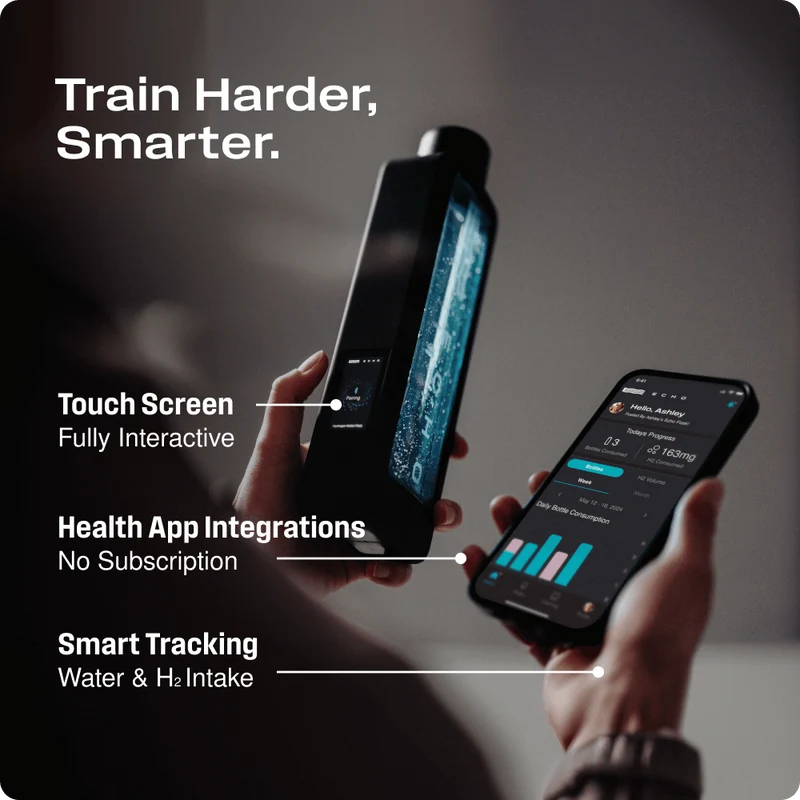
The Flask includes a small touchscreen LCD for local control and Bluetooth for optional pairing. You can run cycles via the touchscreen without pairing, while the app adds tracking and remote options if you want them.
Use it without the app
Out of the box, the touchscreen provides basic control without requiring a phone. That helps in places where Bluetooth isn’t convenient or when you prefer a simple workflow: fill with suitable water, choose a cycle, press start, then release pressure and drink shortly after the run finishes. The display supports light and dark modes and shows simple icons, which keeps the focus on a straightforward start/stop experience.
For readers who wish to keep their setup private or minimal, this approach preserves the hydrogen‑on‑demand function with no accounts or apps. It also reduces battery drain on your phone and eliminates a pairing step when lending the Flask to a family member.
App optional means you can stay entirely on the touchscreen for daily use.
When the app helps
Pairing the app changes what you can see and control. Echo Water notes Apple Health and Android Health integrations, and describes app features for tracking hydrogen intake, water intake and cycles completed, plus being able to schedule, pause, shorten or stop a run from your phone. If you like quantified routines, this turns the bottle into a small system rather than a stand‑alone device. Consider pairing if you want to keep a history of cycles, align intake with an activity log, or queue a 20‑minute run while you finish a task.
Because privacy details aren’t specified on the product page, it’s reasonable to check the app’s permissions on your phone and review the developer’s policy before enabling integrations. When you’re ready to compare details, visit Echo Water to review current information for the ECHO Flask and look for current app notes.
Apple/Android integrations noted lets you decide if health‑app linkage is useful for your routine.
ECHO Flask vs Echo Go+ vs alternatives
Echo’s lineup has evolved. The portable option now centers on the Flask, with the older Echo Go+ referenced for context and a larger 40 oz model in development. If you’re unsure whether you need infusion at all, a standard insulated bottle remains a valid alternative.
| Model | Capacity | Cycle options & brand‑stated ppm | Materials | Controls / App | Battery (brand‑stated) |
|---|---|---|---|---|---|
| ECHO Flask Hydrogen Water Bottle | 12 oz (0.36 L) | 10 min ≈ 6 ppm; 20 min ≈ 8 ppm | PPSU; third‑party testing referenced | Touchscreen; Bluetooth app optional | Up to ~7 cycles per charge (varies with run length) |
| Echo Go+ (reference) | 9.5 oz | 5 or 10 min ≈ ~2.5–4.5 ppm | Polycarbonate | No app sync noted for Go+ | N/A |
| Standard insulated bottle | Varies (e.g., 12–40 oz) | No hydrogen generation | Stainless steel or plastic | None | No battery |
Who each model suits
If you mostly make hydrogen water at home or at your desk and want higher ppm with tracking, the Flask’s 20‑minute run and app features suit that routine better than a short, lower‑ppm cycle. If you need something smaller for quick sessions, the older Go+ specs (9.5 oz and ~2.5–4.5 ppm) illustrate what a shorter cycle can mean: faster turnover with lower hydrogen levels. For a future larger portable format, Echo lists the 40 oz ECHO Forty as a waitlist item targeting 4–6 ppm and shipping early 2027; because it’s not shipping now, plan on the Flask for current availability.
Choose ppm vs cycle time tradeoff to match how you drink: higher ppm often means a longer wait, while shorter cycles lower the stated hydrogen level.
A standard bottle alternative
If you don’t specifically want hydrogen infusion, a standard stainless or plastic bottle will be simpler, cheaper and dishwashable, with no battery to manage. That’s the right choice if you want zero upkeep and no waiting. But if infusion is the priority, focusing on the ECHO Flask Hydrogen Water Bottle aligns with Echo’s current portable design and higher stated ppm relative to the older Go+.
Setup and care checklist
Following the brand’s setup and care guidance preserves performance and keeps the warranty intact. Here’s a concise checklist drawn from the product page and FAQs.
First‑use essentials
- Charge first. Use the included USB‑C cable. The brand notes a calibration period for the lithium‑ion battery; letting the Flask run until it can’t complete a cycle helps the system learn the charge curve.
- Rinse and fill with suitable water. If a small amount of distilled water is inside on arrival, that’s to keep the membrane hydrated. Discard, rinse, then fill with filtered, distilled or RO water for consistent behavior.
- Practice lid handling. Vent, then twist: briefly release pressure, then grip the lid sides and twist off. This avoids fighting pressure against the threads.
- Pick a cycle. Use 10 minutes for a faster run or 20 minutes for the higher stated ppm when you can wait. Expect pressure sounds to vary.
Weekly and monthly care
- Weekly rinse; monthly descale. Give the bottle a light weekly wash with mild soap; run the built‑in Clean cycle as needed. For deeper cleaning, the brand suggests a monthly soak using water plus vinegar—no special chemicals.
- Handwash only. Avoid dishwashers and submersion; those can damage electronics and void the warranty.
- Water policy. Plain water only in the Flask. If you want flavorings or powders, add them later in a separate container; additives in the Flask can interfere with electrolysis and increase buildup.
- Battery rhythm. The brand suggests about 5–7 ten‑minute cycles or 3–4 twenty‑minute cycles per full charge. If you mostly use 20‑minute runs, plan your charge routine accordingly.
- Surface prep. Because small drips from the oxygen port are normal, keep a coaster or cloth nearby in office settings to protect surfaces.
Performance expectations: ppm, taste and timing
Set expectations around ppm, taste and timing by separating what the brand’s lab numbers show from what daily variables can change.
Hydrogen levels and variables
Echo Water publishes H2 Analytics results on distilled water of about 6.07 mg/L after 10 minutes and up to about 8.25 mg/L after 20 minutes. In daily use, mineral content and temperature affect dissolution and retention, so consider those figures an upper bound under optimized conditions. That’s why the site associates the 10‑minute run with ~6 ppm and the 20‑minute run with ~8 ppm—cycle length is a key lever.
Battery and pressure behaviors interact with those settings. The brand lists up to around seven cycles per charge in general, but also notes a practical split: more short cycles per charge than long ones. If you frequently run 20‑minute cycles, keep your cable handy.
Drink window and taste
Hydrogen doesn’t stay in water indefinitely. Hydrogen dissipates over time, so the brand suggests enjoying your drink soon after the run finishes. Taste expectations are simple: the FAQs say hydrogen water tastes like water, with no added flavor, aftertaste or texture changes. If you prefer chilled water, cool your input water first; chilling afterward can agitate the liquid and hasten gas loss.
Finally, remember scope. Hydrogen water is positioned by the brand as safe to consume, and their FAQ references recognition of hydrogen gas as GRAS. That’s a safety context, not a promise of outcomes. Judge the Flask primarily on whether on‑demand hydrogen and the stated ppm will add value to your own hydration routine.
Buying, warranty and returns
Before you buy from Echo Water, review the brand’s current coverage and regional availability. Policy pages can change, and delivery terms vary by destination.
Purchase coverage
The product page lists a Stated 5-year limited warranty on the Flask, with shorter coverage on included accessories. Echo also references third‑party testing and a PFAS report for the Flask. If you want additional protection, the site mentions an optional plan called Echo Care that extends coverage beyond manufacturing defects. For UK buyers, confirm whether warranty administration and any optional protection are available in your region before purchase.
Returns and shipping basics
The same page notes a Stated 60-day return policy processed through Echo’s portal, and U.S. shipping guidance of roughly 2–7 days after dispatch, with free‑shipping thresholds applying to the contiguous U.S. Because you’re buying from a global site, check the shipping and returns pages for your country at checkout.
Next step: if the tradeoffs make sense—short waits, a small 12‑ounce batch size, periodic cleaning—and the ppm range is what you want, visit Echo Water to compare current ECHO Flask specs, review the warranty and returns text, and confirm availability for your location.